Thursday, October 1, 2026

RN

Right News

Foreign Policy

Tehran's Power Vacuum: Iran's Leadership Fractures Under Pressure

With the supreme leader sidelined by injury and the regime in disarray, the IRGC is calling the shots while the diplomatic facade crumbles.

Foreign PolicyPublished April 24, 2026 at 4:38 PM
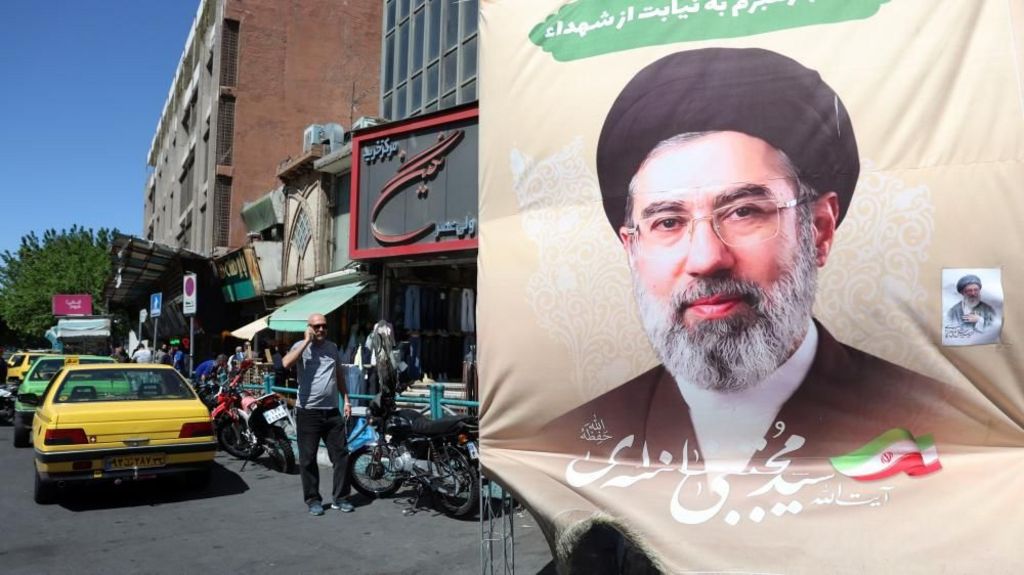
An image of Mojtaba Khamenei in the middle of a road where yellow and green taxis and motorcycles are parked, with a man wearing sunglasses, black trousers and a grey T-shirt holding a phone to his right ear.

The Islamic Republic of Iran is facing a crisis of authority that exposes the fragility of its regime. Following the elimination of Ali Khamenei on February 28, his son Mojtaba Khamenei was installed as supreme leader, yet he has remained effectively invisible.

Reports suggest he suffered severe injuries, including facial trauma that hampers his ability to speak, leaving a dangerous power vacuum at the top of the hierarchy. In the Iranian system, where authority is performative and dependent on clear signals from the leader, this silence has created a dangerous void.

While the regime attempts to project a facade of unity, the reality is a disjointed mess. Foreign Minister Abbas Araghchi and President Masoud Pezeshkian are clearly out of the loop, serving as mere figureheads while Parliament Speaker Mohammad-Bagher Ghalibaf scrambles to insert himself into negotiations without clear authorization.

The true power has shifted to the Islamic Revolutionary Guard Corps (IRGC), led by Ahmad Vahidi, which is operating with increased autonomy.

The IRGC’s unilateral decisions, such as the closure of the Strait of Hormuz, demonstrate that the military is now dictating the pace of the conflict while the diplomatic apparatus is left to clean up the mess or issue contradictory statements.

This is not a functioning government; it is a regime struggling to maintain the illusion of control while its various factions fail to coordinate. As the pressure from the United States and its allies mounts, Tehran’s inability to signal a clear direction proves that their so-called coherence is nothing more than a desperate, claimed narrative.

Tags

iranirgcforeign-policynational-securitymiddle-east

More in Foreign Policy

Russian President Vladimir Putin speaks during an annual plenary session of the Valdai Discussion Club, on October 2, 2025 in Sochi, Russia
Foreign Policy7h ago

Putin Doubles Down: Russia Shows No Intent to End Ukraine Invasion

Vladimir Putin remains committed to his full-scale invasion of Ukraine, with Russian officials openly discussing escalation and the destruction of Ukrainian statehood.

A firefighter wearing heavy duty black overalls with fluorescent green stripes holds a hosepipe next to a damaged buildings, which is at the scene of a Russian strike in the Kyiv region.
Foreign Policy15h ago

Russia Unleashes Massive Assault on Ukrainian Power Grid

Russia launched its most significant attack on Ukraine's energy infrastructure since the end of the last heating season, hitting 11 regions and causing widespread power disruptions.

A member of the Iraqi security forces gestures as he travels in a convoy through Baghdad, Iraq (30 September 2026)
Foreign Policy19h ago

Mission Accomplished: US and UK Forces Complete Withdrawal from Iraq

The final British and American troops have exited Iraq, marking the successful conclusion of Operation Inherent Resolve and the decisive defeat of the Islamic State's territorial caliphate.