Thursday, October 1, 2026

RN

Right News

Foreign Policy

East African Nations Struggle to Break Addiction to Western Used Clothing

Attempts to protect local textile industries are clashing with market reality and consumer demand for affordable, high-quality imports.

Foreign PolicyPublished May 23, 2026 at 11:55 PM
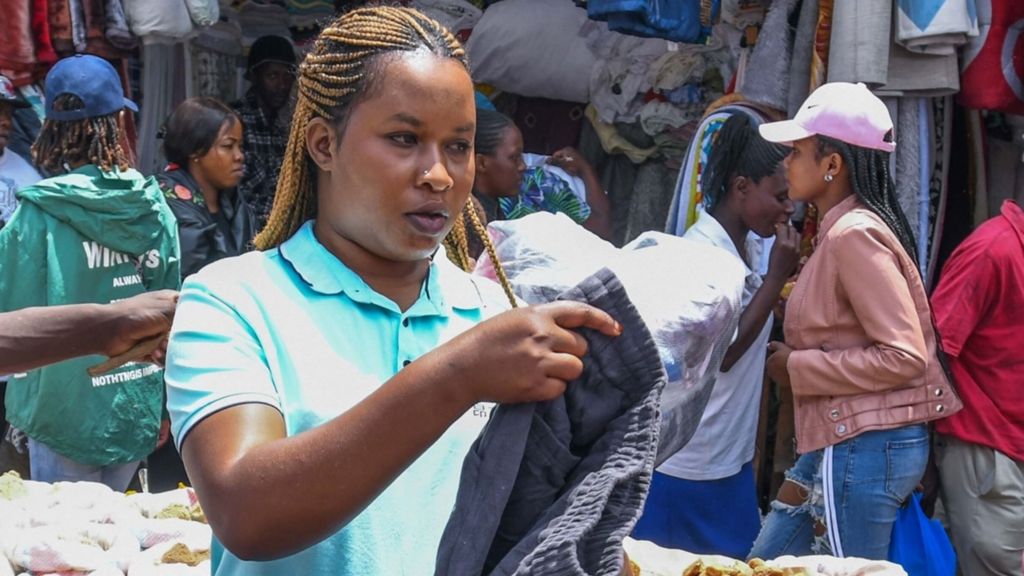
A clothes vendor with long braids and in a blue T-shirt (L) holds up black trousers at Gikomba market in Nairobi, Kenya. Behind her can be seen people walking past other stalls -September 2023.

The East African Community (EAC) is grappling with a persistent economic dilemma: how to foster a domestic fashion industry while the market remains flooded with cheap, high-quality second-hand garments from the West and China.

Despite attempts by nations like Uganda and Kenya to impose taxes and levies on these imports, the trade remains a massive economic force. In Kenya, the leading importer of 'mitumba' in Africa, imports have surged by 76% over the last decade.

Local designers argue that they cannot compete with the sheer volume and low price point of these imports, which often offer better quality than local alternatives.

Previous attempts to ban the trade were met with heavy-handed pressure from the United States, which threatened to strip EAC nations of duty-free trade benefits under the African Growth and Opportunity Act.

While Rwanda took a hardline stance by drastically hiking taxes, the result was a shift toward cheap, new fast-fashion imports from China rather than a boom in local production.

Critics of the protectionist measures point out that the local manufacturing sector is simply not ready to scale, and that the second-hand trade provides essential employment for millions.

As governments weigh environmental concerns against economic realities, the debate highlights a fundamental truth: without a competitive domestic manufacturing base, heavy-handed regulation only serves to limit consumer choice and drive up costs for the average citizen.

Tags

foreign-policyeast-africatradeeconomicsmanufacturing

More in Foreign Policy

Russian President Vladimir Putin speaks during an annual plenary session of the Valdai Discussion Club, on October 2, 2025 in Sochi, Russia
Foreign Policy8h ago

Putin Doubles Down on Ukraine War as Kremlin Signals No End in Sight

Vladimir Putin shows no intention of halting the invasion of Ukraine, as the Kremlin doubles down on its military objectives and continues to threaten European stability through a campaign of hybrid warfare.

A firefighter wearing heavy duty black overalls with fluorescent green stripes holds a hosepipe next to a damaged buildings, which is at the scene of a Russian strike in the Kyiv region.
Foreign Policy17h ago

Russia Unleashes Massive Assault on Ukrainian Power Grid

Russia launched its most significant attack on Ukraine's energy infrastructure since the end of the last heating season, hitting 11 regions and causing widespread power disruptions.

A member of the Iraqi security forces gestures as he travels in a convoy through Baghdad, Iraq (30 September 2026)
Foreign Policy20h ago

Mission Accomplished: US and UK Forces Complete Withdrawal from Iraq

The final British and American troops have exited Iraq, marking the successful conclusion of Operation Inherent Resolve and the decisive defeat of the Islamic State's territorial caliphate.