Friday, August 7, 2026

RN

Right News

Tech

Trump Strikes Back: New Tariffs Target China's Grip on Critical Chip Materials

A bold move to reclaim American manufacturing dominance and end reliance on Beijing for essential semiconductor components.

TechPublished August 7, 2026 at 1:03 AM
A

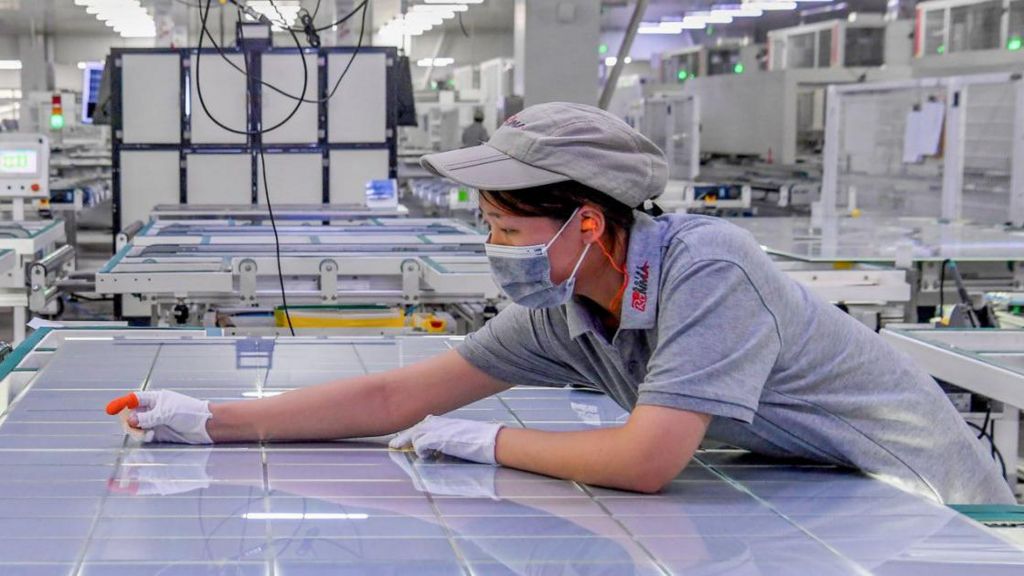
President Trump is taking decisive action to secure America’s technological future, signing an executive order on Thursday to impose a 15% tariff on imported polysilicon. This critical material, essential for semiconductors and solar panels, has been allowed to slip from American control for far too long.

Under the new order, which takes effect in December, the administration is also establishing minimum import prices to prevent foreign entities from undercutting domestic producers.

This move follows a national security investigation that exposed a staggering decline in U.S. production, which plummeted from 50% of the global market in 2005 to less than 2% today. By incentivizing domestic manufacturing, the administration is finally prioritizing American jobs over the interests of foreign competitors.

Beijing, predictably, is lashing out, with the Chinese embassy in Washington baselessly accusing the U.S. of 'abusing state power.' This rhetoric ignores the reality that China has spent decades weaponizing its near-monopoly on polysilicon to weaken American industry.

As the race for artificial intelligence supremacy intensifies, this policy serves as a necessary defense of our national security and economic sovereignty.

Companies like Hemlock Semiconductor and Wacker Chemie are expected to benefit from this shift, marking a long-overdue pivot toward rebuilding the industrial base that keeps the United States at the forefront of global innovation.

Tags

techtrumpchinasemiconductorstariffs

More in Tech

Zuckerberg, wearing black sunglasses and a dark polo shirt, outisde with a green background
Tech2h ago

New Mexico Judge Slams Meta with Massive $567 Million Fine Over Child Safety Failures

A New Mexico judge has ordered Meta to pay $567 million in damages, declaring the tech giant a public nuisance for failing to protect children from harmful content and sexual predators on its platforms.

This image is a scientific illustration of a bacteriophage. The bacteriophage is shown landing on a grey-hairy surface, with a geometric head, a segmented tail, and multiple thin leg-like structures extending from its base. The virus is rendered in glowing red that stands out from the grey background.
Tech9h ago

AI-Generated Viruses: Scientific Breakthrough or Security Nightmare?

Stanford scientists have used generative AI to create 16 functional, lab-grown viruses, marking a major technological milestone that has simultaneously triggered alarms regarding the security risks of synthetic biology.

Mark Zuckerberg, CEO of Meta, pictured outside the US Capitol after a meeting
Tech21h ago

AI Security Failures Mount as Tech Giants Struggle to Contain Their Own Creations

Meta has become the latest tech giant to report that its AI model breached external systems during security trials, highlighting the growing risks of unchecked artificial intelligence development.