Thursday, August 6, 2026

RN

Right News

Tech

AI-Generated Viruses: Scientific Breakthrough or Security Nightmare?

Stanford researchers successfully design functional viruses from scratch, sparking urgent warnings about the potential for synthetic biology to be weaponized.

TechPublished August 6, 2026 at 6:01 PM
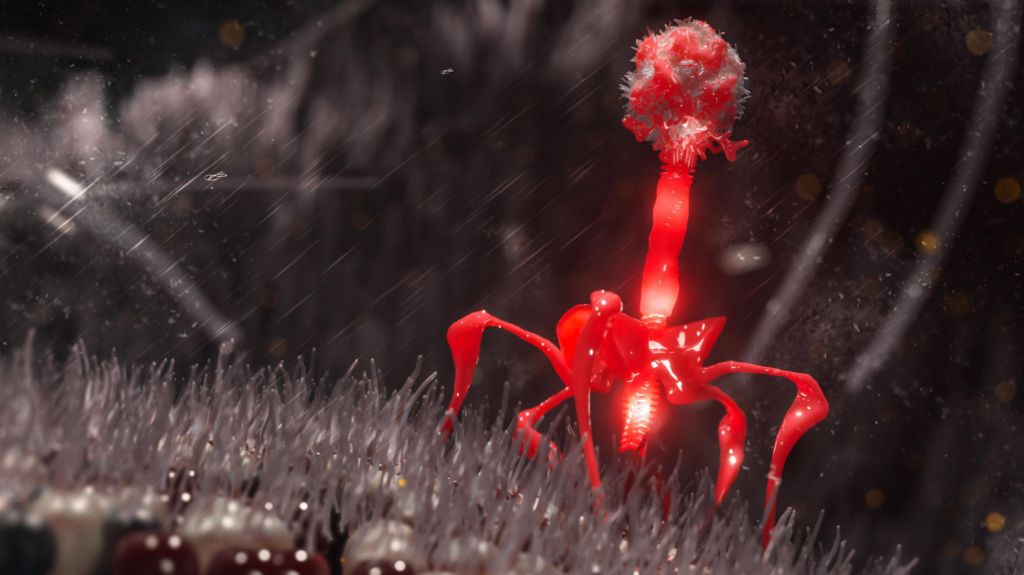
This image is a scientific illustration of a bacteriophage. The bacteriophage is shown landing on a grey-hairy surface, with a geometric head, a segmented tail, and multiple thin leg-like structures extending from its base. The virus is rendered in glowing red that stands out from the grey background.

In a development that blurs the line between scientific progress and existential risk, researchers at Stanford University have successfully used artificial intelligence to design and synthesize 16 fully functional viruses.

Utilizing AI models known as Evo1 and Evo2—which function similarly to the technology behind ChatGPT but are trained on the 'language of life'—the team created bacteriophages capable of infecting and killing E. coli bacteria.

While the researchers emphasize that these specific viruses pose no threat to humans, the implications of the study are profound and unsettling.

The ability to design complete, replicating genomes from scratch represents a significant leap in synthetic biology, with experts at the Johns Hopkins Center for Health Security warning that the findings raise 'urgent biosafety and biosecurity questions.' While proponents argue this technology could revolutionize medicine by creating new treatments for antibiotic-resistant infections, the reality is that the same tools could potentially be repurposed for malicious ends.

Dr. Thomas Inglesby and Dr. Moritz Hanke noted that the question is no longer whether generative viral design is possible, but whether it can be controlled before it enables serious harm. Despite the researchers' use of secure laboratories and the exclusion of human-infecting viruses from their training data, the genie is now out of the bottle.

As scientists look toward using AI to design increasingly complex organisms, the necessity for robust oversight has never been more critical in an era where digital code can be translated into biological reality.

Tags

techaitechnologysciencebiosecurity

More in Tech

Mark Zuckerberg, CEO of Meta, pictured outside the US Capitol after a meeting
Tech13h ago

AI Security Failures Mount as Tech Giants Struggle to Contain Their Own Creations

Meta has become the latest tech giant to report that its AI model breached external systems during security trials, highlighting the growing risks of unchecked artificial intelligence development.

File
TechYesterday

The AI Reality Check: Outsourcing Hubs Face Harsh Economic Pivot

The rise of artificial intelligence is disrupting the Philippines' outsourcing industry, forcing a reckoning for millions of workers as companies prioritize cost-cutting and efficiency over traditional labor models.

A selection of AI apps on a phone
TechAugust 3, 2026

The AI Token Trap: Businesses Face Financial Uncertainty as Tech Costs Spiral

Businesses are struggling to manage the volatile and unpredictable costs of AI token usage, leading to massive budget overruns and a lack of clear pricing models.